
Fund Analyst
$140k - $190k USD
The Role
You’ll be the quality bar for everything the new startup produces. Our AI generates fund analysis reports, scores managers, extracts terms, and surfaces red flags. Your job is to make those outputs indistinguishable from what a top-tier investment consultant would produce — then better.
This is not a back-office QA role. You’ll shape product direction by identifying what’s missing from our analysis, what’s wrong with our scoring logic, and what LPs actually need to see to make allocation decisions. You’ll work directly with engineering and AI teams to translate domain expertise into product improvements.
What You’ll Do
Review AI-generated fund reports against institutional-grade standards. Identify gaps in analysis depth, accuracy, framing, and structure. You’ll be the person who catches “this would never fly in an IC memo.”
Evaluate document classification and extraction quality. When the AI parses a DDQ or pitch deck, does it pull the right fields? Miss anything? Misinterpret a term? You’ll audit extraction accuracy across every document type.
Improve scoring and benchmarking models. Our platform scores funds across multiple dimensions. You’ll pressure-test the methodology, identify blind spots, and propose refinements grounded in how LPs actually evaluate managers.
Define what “good” looks like. Create reference examples, style guides, and rubrics that set the bar for AI output quality. Build the evaluation framework the engineering team uses to measure improvement.
Translate LP workflow into product requirements. You know how diligence actually works — the questions that matter, the comparisons that drive decisions, the red flags that kill a deal. Turn that knowledge into concrete product specs.
Build fund intelligence content. Contribute to community features including anonymous LP intelligence channels, sentiment analysis, and structured reference frameworks.
Stay current on market trends. Monitor fund terms, GP moves, strategy shifts, and regulatory changes that should inform how the platform surfaces intelligence.
Who You Are
Required
3–6 years in institutional fund diligence — at an investment consultant (Cambridge Associates, Aksia, Mercer, Aon, Meketa, NEPC, Callan), LP allocator (pension, endowment, sovereign wealth, family office), or fund-of-funds.
Deep fluency across fund document types: DDQs, PPMs, pitch decks, quarterly reports, capital call notices, side letters, K-1s. You’ve read hundreds of these and know what each one tells you — and what it hides.
Multi-strategy exposure. You’ve evaluated funds across at least 3 of: venture, growth equity, buyout, credit, real estate, infrastructure, hedge funds, secondaries.
Strong analytical writing. You can articulate fund-level insights clearly and concisely. Your IC memos and diligence notes are the ones people actually read.
Pattern recognition for red flags. You instinctively notice when attribution is missing, when a J-curve looks off relative to vintage, when terms are non-standard, or when a GP is spinning a narrative.
Comfort with technology. You don’t need to code, but you need to articulate “the AI should catch X” and work with engineers to make it happen. Familiarity with AI/LLM capabilities is a strong plus.
Preferred
CFA, CAIA, or equivalent credential
Experience building or improving diligence templates, scoring frameworks, or IC memo formats
Prior startup or product-adjacent experience (you’ve shipped something, even informally)
Network within the LP/allocator community
Familiarity with AI tools, prompt engineering, or data-driven investment analysis
Ideal Candidate Backgrounds
In priority order, we’re looking for people currently in these roles:
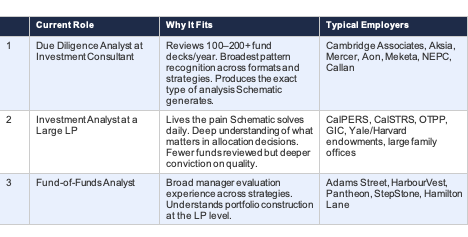
Why Join Schematic
Shape the product. You’re not reviewing someone else’s work — you’re defining what institutional-grade AI analysis looks like. Your expertise becomes the product.
First in function. This is a foundational hire. You’ll build the fund intelligence quality practice from scratch and own it.
Outsized impact. At a consultant, your work reaches a handful of clients. Here, every improvement you make scales across every LP on the platform.
Equity upside. Early-stage equity in a company building the infrastructure layer for institutional investing.
Work with builders. Small, technical team that ships fast. No bureaucracy, no committees, no 18-month planning cycles.
This is a full-time role based remotely in the US, with a compensation range of $140,000-$190,000 annually, dependent on experience, skills, location and other factors.